Sunday, September 16, 2012

DURGA POOJA

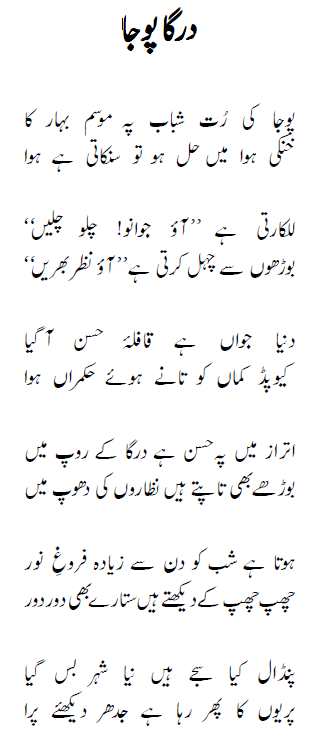
The spring is at its highest in the Pooja season,
Melting cool in the air is exciting.

Exhorts, "Come O! youth! Let's go",
Cuts jokes with the old, "Come! Let's have a look."

The world is youthful, the caravan of Beauty has arrived,
Cupid with drawn bow is ruling.

Beauty descends on earth in the garb of Durga,
Even the old are singing in the warmth of scenes.

There's more brilliance at might than in the day,
Even stars are peeping to see from afar.

Pendals are decorated as if a new town has emerged,
Flocks of fairies roaming about wherever you see.

Knots of hairlocks are more knoty at places,
Dark clouds are no match for the flowing hairlocks.

Look! Lighting is stricking all around,
O God! Save the heart's haystack.

Lovers have descended in the lanes and streets of the city,
Rivals too have come to get heart's desire fulfilled.

The old and the young moving about in colourful garments,
How the weak are striding with puffed up bossom!

Wonderstruck lighting turned into idol having, seen Devi's silver body,
Moreover, wrapped in glistening clothes.

A portrait of splendor, eminence personified,
Matchless in grandeur, glory and greatness.

The Power rules but in peace,
Hand raised for protecting the weak.

Devotess crowding everywhere in the town,
All, small and the big are receiving blessings.

Paying a visit to Mother Durga bestows peace and solace,
Even those with bruised hearts are comforted.

Agree, she is hear for a few days, so what,
The man is somewhat relived of the poison of grief.

With the departure of Durga the inner light is gone,
All spectators of the bride are gone.

The city with a drawn face, is in sorrow,
But hopes that she will visit again.

The potter rears that hope for the whole year,
They fix hair and feather in the clay idol.

This idol making of their's is matchless,
They are Azars* of their time with perfections in their art.
--------------------------------------------------------------------------------------------------
* Azar, father of Abraham, was a famous idol maker.


Saturday, July 14, 2012

What is happening to your heart tell a little to someone,
Who has the heart to listen, but still speak to someone.

Worldly grief would lighten by telling it to someone,
When the grief is not worldly what could be told to someone.

Whenever the heart wells-up for no reason what can be done,
Come on! True! for God's sake speak to someone.

Has someone realised the shock of a shattered dream?
No longer is the dream, even if it remains, so what! tell to someone.

Loneliness is sucking blodd from every breath
This anguish, pain and pang and misery! tell to someone.

Oh! How long you are carrying on this burden on your heart!
Forget, past is past, speak to someone.

Rizwan! It is nothing to turn as the wind blows,
If you have ever turned the wind, tell to someone.


Of the ignorant bud I'm afraid,
Of the flower's end I'm afraid.

Getting stones in return for flowers,
Of flower's name I'm afraid.

Who knows how much is the granted time!
Of the morn, of the eve, I'm afraid.

Come let's get together without cup and jar,
Of the cup going round I'm afraid.

Seeing holy and unholy precincts' conflict,
Of every door and terrace I'm afraid.

Me, in the bond of love and courtesy,
Of a trapless bond I'm afraid.

They say, "Who would stand by Rizwan!"
Of such a nondescript I'm afraid.
No guest has ever visited this lonely habitat since its very inception!
None is singing, no where is the henna colour!

Bare branches longed for leaves and fruits even for once!
There is no pleaser in watching empty spheres.

Storms are still nursed under thick shrouds of silence,
How could the silence be broken! None has touched the heart yet.

They are coming to end, the moments of life were already numbered,
But there is such a heat and vigour in breath as if the sun is not down yet.

Those wandering on streets, beaten by day's heat,
If get to their desitination by the dusk, there is nothing bad about it.

What could not push travelers up to their destinations
That could be the noise of passes by, that can never be my call.

Wake up Rizwan before the time for closing eyes comes,
While stars are still twinkling the down is yet to break.


The pain is rather severe, don't ask,
The pain is incurable, don't ask.

There was time when I had my days,
What I possessed, don't ask.

Just a gracious look,
Changed what was into what it is, don't ask.

Intoxicated with the ascetic drink,
The possession of the dispossessed, don't ask.

In my dust rests
The fire of Karbala, don't ask.

Granted a world, but what did ye bestow!
My God! Don't ask.

The heart breaks, it is said,
The intensity of the pain! Don't ask.

What a wreck and break,
How hot is the wind! Don't ask

All of it was his, whatever it was,
What remains mine, don't ask

Eyes of a lovely fawn!
It's a pleasant dream, don't ask.

Benevolence and cruelties,
For me all are justified, don't ask.

I did not say anything,
But what he said, don't ask.

Oh! That burning passion!
Oh! The pang! Don't ask.

Far from the repose, in a thoroughfare,
You'll find him whom you never get at home even by mistake.

The secret sought after in the Sacred Arch,
Settled in the heart, then why look for within walls and in the opening?

That thing is too old, the stories are of the long past,
When there was a craze in the head by day and night.

Do they not face the turmoil of the time?
Daring are those who are brought up in the whirlpool.

Stopped for a breath, is it losing the heart?
There is still energy in the wings for flight.

There is no provision for journey except feet boils
God knows the destination, but I am travelling.

There is no desire in the broken heart,
Does one live in a deserted ruin?

There was another time when evenings were morning like,
Rizwan there is no pleasure now either in the night or in the morning.


Saturday, November 19, 2011

Old Pains Are Awakened


What easterly wind is blowing today!
The old pains are awakened
Sitting under the passing shade of time,
I was writing my story,
Laughing and weeping,
Had forgotten the old pain.
But tell me my dear,
What easterly wind is blowing today!
The old pains are awakened.
Me, the crazy one, was driven out of the town,
What had I to do with the town?
The burden of pain should have been left behind,
Why it should have been carried on?
Rizwan, was that burden not enough?
What easterly wind is blowing today!
The old pains are awakened.
Some old dreams are awakened in the wet eyes,
Some wounds are opened, some pains increased.
Some old pains are awakened.
What easterly wind is blowing today!
Tell me my dear!


Following The Trail


Where all the people are running to
Riding the shoulders of the air?
Don't look back even,
A crowd is running behind them.
Whom should I ask where you are going to?
What is the destination,
With no address or a sign?
If want to know, accompany them,
But who knows,
Where they might lead to.
And never to return,
Tell nothing to the people,
And in the same way people continue to walk
Like an endless caravan.

The Legacy


This show of luxurious things,
The crowd of charming faces,
Or the death of hopes of hundreds of thousands.
Who does not want a comfortable living?
Who does not seek comforts?
Which is not the season of love?
But those are the seasons of injuries.
If the show brightens with silver and gold,
Then the sight of the world is worth seeing,
Otherwise the moonlight is deathly pale.
For a time the heart was restless in the side,
There was a turmoil and craze.
But this adversity be damned!
Carrying my ego on my palm,
Which was my blood-money.
What will I do with this valueless thing!
God forbid! It becomes the legacy,
That bites my children

Dilli Nama

In Lighter Vein

In Lighter Vein

GAJAL A PHARSI RECIPE
by Rizwan ullah


Originally patented as 'Ghazal' in Pharsi is vociferated as 'gajal' in desi bhasa. It is a sort of khichri prepared according to a Pharsi recipe. The blend was introduced in Hindustan by Mogul confectioners, wanderers and peddlers of various sorts just as we have pepsi, cola, pizza among the recent taste teasers. The Pharsi khichri was originally cooked in arrack much hyped by Hafiz and Khayyam and others of their tribe. It reached Hindustani mandi high and dry, again like cola concentrate, and was received with great acclaim sans Mnadi House courtesy. The original colour of the mash was pink and violet.

As we Hindustanis have developed a great liking for hot and strong tastes which is one of the surviving vestiges of Mogul diversities, Lots of mussala was added to prepare wide varieties of the original preparation so as to make it presentable and acceptable to all tastes. Early experiments were made with waters fetched from the Dajla (Tigris) and the Farat (Euphrate). Later, waters of the Ravi and the Chenab of Punjab were experimented with, but waters of the Ganga and the Jamuna, not so much polluted then, proved to be the most suitable indigenous ingredients and more digestible as well. These waters have proved their excellence when milk is mingled with it or when it is sprinkled, of course with a devotional intent, over a large variety of commodities as far apart as sugar, coal and firewood.

History has from the time immemorial used Hindustan as a vast caldron for mixing all sorts of things such as races, religions, languages, cultures, traditions to prepare an acceptable social ketchup. Similarly the Khichri of gajal was prepared by mixing all sorts of ingredients in the Hindustani climes such as rose, thorn, stone sweat. Even non-veg ingredients like blood, pieces of broken heart and minced liver were added. Surprisingly, the preparation was relished by the veg and the non-veg alike. Sweet, sour and bitter tastes were abundantly available to be served on all occasions either in earthenware made by the kumhar the potter and sold at a throw away price, and hence preferred by our great Galib Sahab, or in goblets made in European potteries for the class conscious. However, the muck was prepared widely from the lanes of Dilli to every Urdu medium primary school anywhere, thankfully they are on the decline.

As the days passed the commodity changed hands with generations of traders. Our traders have proved their enterprising excellence in selling all sort of commodities including language and religion. So after promoting preparations like idli, dosa, papad, pickle, pakora in the West they took to exporting the khichri called gajal to the Middle East, West and far West and fetched hard currency. For this they had to hire the services of promoters from amongst the Hindustani diaspora who formed societies and organized contests for vocal presentation of gajal. Reportedly they are doing good business as the people with surplus money in the des of plenty can spend on anything just for the sake of a change.

The choice of colour has also been taken good care of so it is available in rosy, tulip, red, emerald green, saffron and marigold colours. In fact Galib Sahab and before him Mir Sahab were the best producers of the original brand. But for the succeeding promoters like Hali and Azad the brew would have fallen on dull tastes after the fall of their Mogul patrons and Nawab followers.

God bless our law makers they relish all old and new brands of the khichri, that is gajal, with that they get their strained nerves soothed and agitated emotions relaxed, in a state of rage it can be splashed on the rival's face without causing any damage to the person or property. Thus provision of a khichri cafe adjacent to the houses seems to be a sound suggestion.


GROWING THE BEARD


The razor's edge as usual,
Was face to face with my beard,
Quizzed rather harshly,
For the first time in fifty years,
The barbs should you grow and pop
the speckle fins?
To prick the arms at night?
And frighten the mirror at dawn?
Presto cam the answer!
Why not quiz the whiskers, trimmed to size,
To snoop and spy
On the in and out of the nostrils?
That blow with gusto;
The vile mustache that grow and align along the lip,
Propped by the façade of dwindling teeth
That bare in anger and shiver in pain?
The poor beared!
Fumed froth and vanished.


NEXT DAY


The razor been shy the other morn,
For what had passed, its edge was worn;
It made a break from the yester past,
And the break for days did last;
Thus the beard got respite,
Dropped the quarrel and the fight;
Played in sun with rays that shine,
Chummed with chin, with neck did whine;
The shady sheep, the few w're happier,
As they too were reaped with rapier;
The saying goes that the poor weevil,
If ground with wheat, is not evil,
Askance looked the men around,
Look miserable as they found;
Rushed relatives feigned their sorrow,
Friends promised to come 'tomorrow';
Urchins called me Baba Baba!
Alla, Alla; Toba, Toaba!!
Sunday, October 30, 2011

Where does the heart mix?

Where does the heart mix with everyone?
It does mix with you only.

You did not come so I came,
Whether the sea goes to meet with the river?

The experience that could never be described,
Is gotten at the end of life.

The moth attains the (exalted) state non-existence,
From the intense heat of love.

My eyes are fixed for a long time on the one,
Whose face resembles with someone.

Adversity may take one anywhere,
Who goes to meat with someone with pleasure!

Rizwan who is humble like me?
Who meets with such humility?

Sunday, October 16, 2011

Urdu Journalism of Calcutta and me

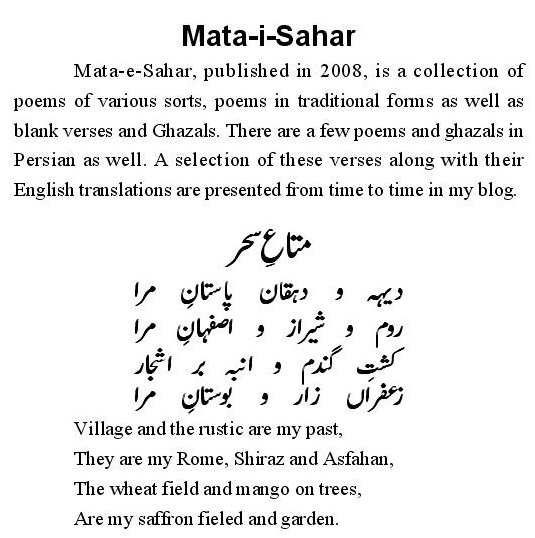
Mata-i-Sahar


Persians Poet of Awadh

Opening Quatrains

Picturesque Pages


UNITE FOR A NOBEL CAUSE


The Nobel Prize for literature this year has gone to a Swedish poet. Writers and poets of various languages have been similarly honoured in the past. We had Rabindra Nath Tagore almost a century ago. Urdu, like English, had its origin in a particular era and in a particular area, then the language began expanding and spreading in all dimensions and directions, and at the same time went on borrowing, bartering and assimilating words and ideas from other languages that came in close contact. Through this process of give and take Urdu has already assumed an exalted position in the comity of languages. Is it not the time for the Urdu world to start the exercise for finding, proposing and promoting a suitable name for a Nobel Prize? Desire is a powerful engine to drive upto the desired goal.


Rizwanullah

Oct. 12, 2011